

(As an Amazon Associate, I earn from qualifying purchases.)
If you’re thinking about cooking outside this summer, there’s a moment that tends to arrive right after the first couple of sunny weekends. You roll the grill into position, you’ve got guests drifting in and out of the kitchen, and you realize the bottleneck isn’t the grill, it’s everything around it. The cutting board ends up balanced on a tiny side table. The seasoning disappears back inside. Someone asks where the paper towels are, and you do that little panicked scan of the patio for a clean surface to set a plate. That’s the exact problem an outdoor kitchen island cart like this one is meant to solve: not “make you a better cook,” but make the whole flow feel calmer, cleaner, and more put together
This particular model is a 54.5-inch outdoor kitchen island cart that appears under “generic” labels in different stores. That isn’t automatically good or bad; it just means it’s worth judging it the way you would any private-label outdoor cart: by the design, materials, capacities, and whether the dimensions match how you actually cook and host.
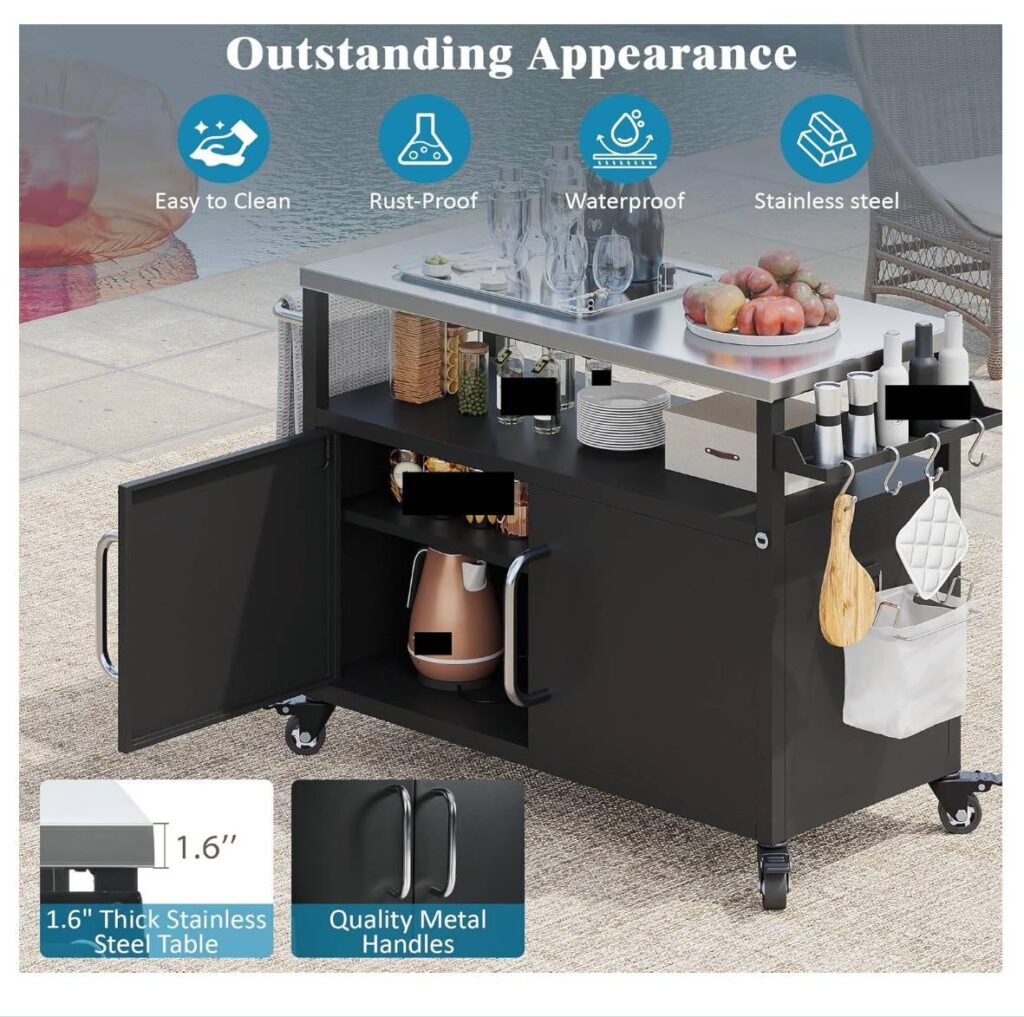
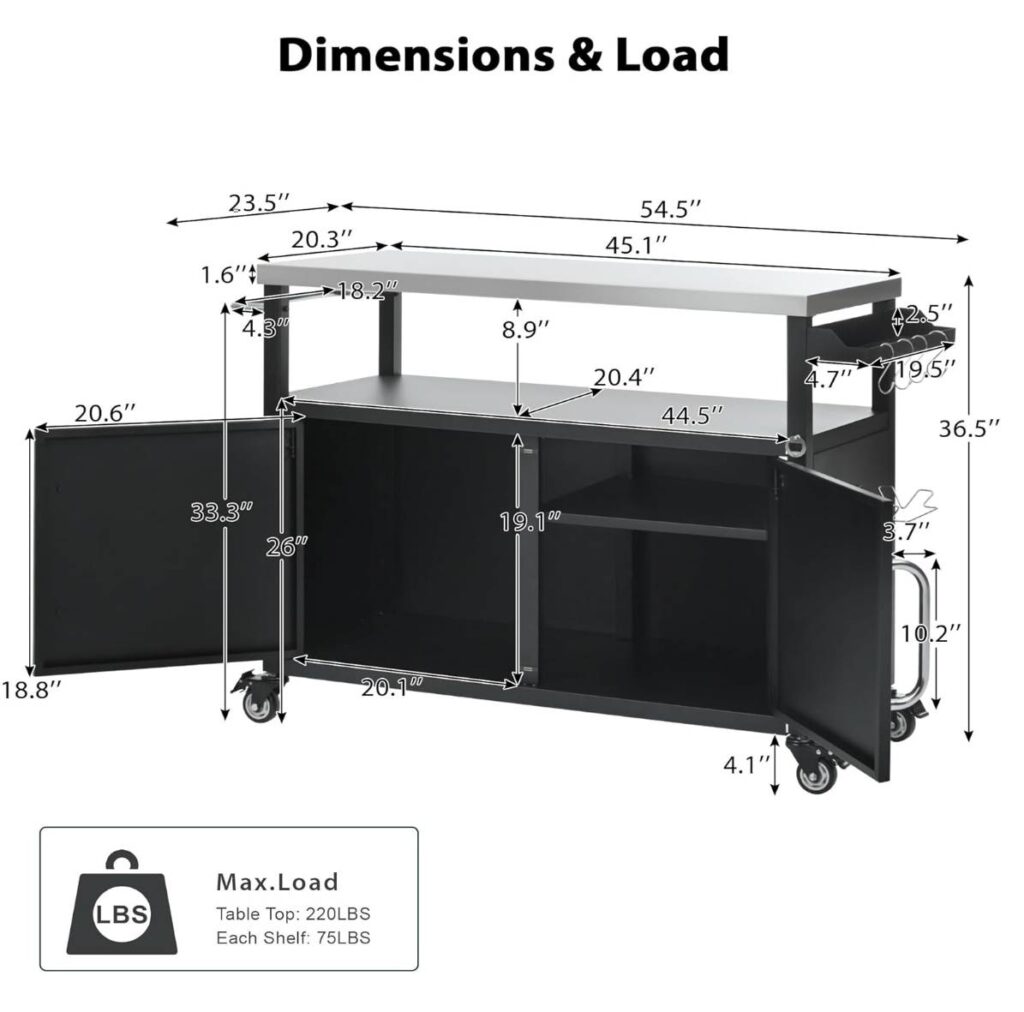
The first thing that makes this cart worth considering is that it’s built to function like a real prep station, not a decorative serving trolley. The overall footprint is commonly listed around 54.5 inches wide, 23.5 inches deep, and about 36.5 inches tall. That height sits in a comfortable “counter-ish” range for most people. High enough that you’re not bending over to chop, but not so tall that it feels like a bar table. It’s also big enough to live next to a grill without feeling like an afterthought: you can stand between the grill and the cart and do that efficient two-step rhythm of flip, season, plate, repeat.
The work surface matters more than people expect. A lot of outdoor carts look generous in photos, but in real life the top is either too small to prep properly, or too thin to feel stable when you’re slicing something firm. For this model, the stainless steel tabletop is typically described at roughly 45.1 inches by 20.3 inches, with an overall top thickness around 1.6 inches. Listings also often mention a high tabletop weight capacity (around the low hundreds of pounds), which is a reassuring signal that you can load it with a cutting board, a stack of trays, and a heavy platter without feeling like you’re testing its limits.
Stainless steel is a practical choice for outdoor prep for two reasons. First, it’s forgiving when it comes to mess: marinades, grease, citrus, and sauces wipe down without permanently soaking in the way some wood or composite tops can. Second, it’s temperature tolerant; a hot tray or a warm pan is less likely to cause damage than it would on a plastic or painted surface. It does mean fingerprints and water spots can show up, but that’s the trade-off for a surface you can actually clean quickly between tasks. If you treat it like outdoor furniture, wipe it down, avoid harsh abrasives, and cover it during heavy rain. It’s the kind of surface that can stay looking presentable through a lot of backyard meals.
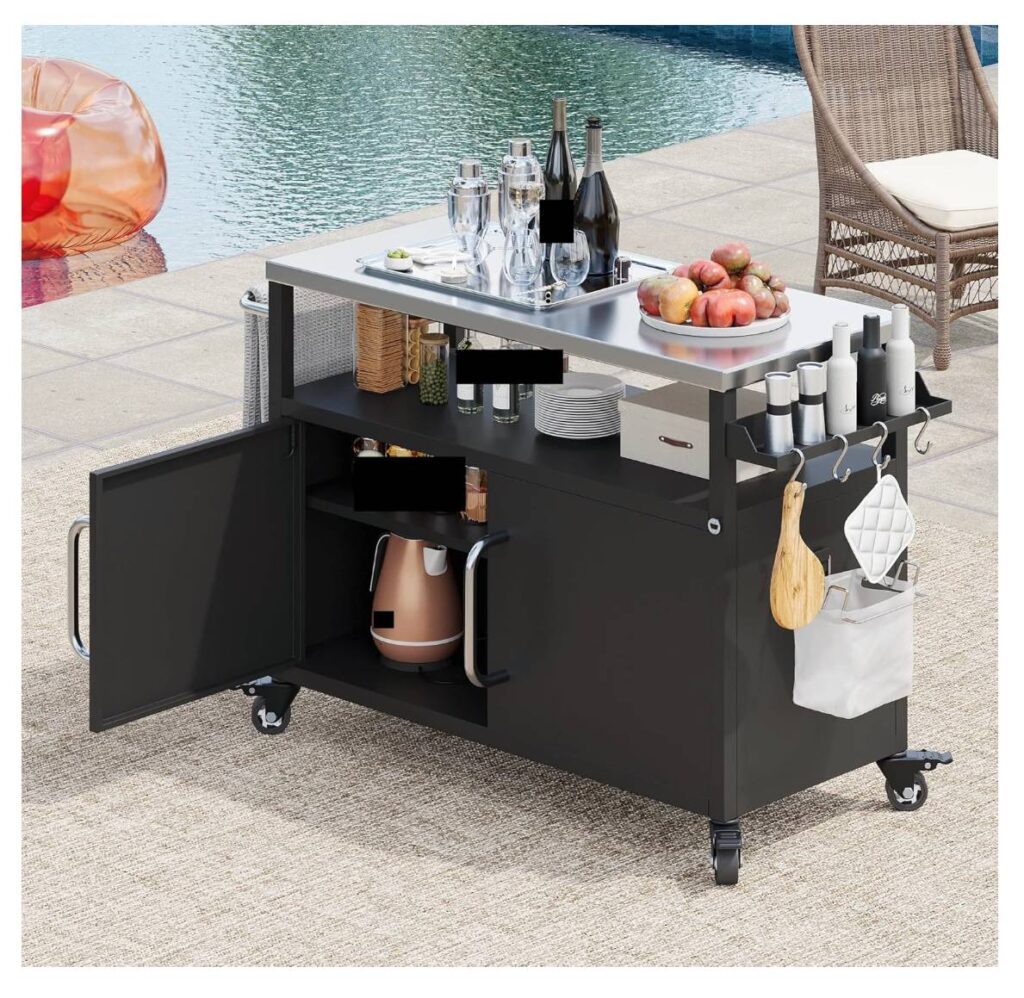
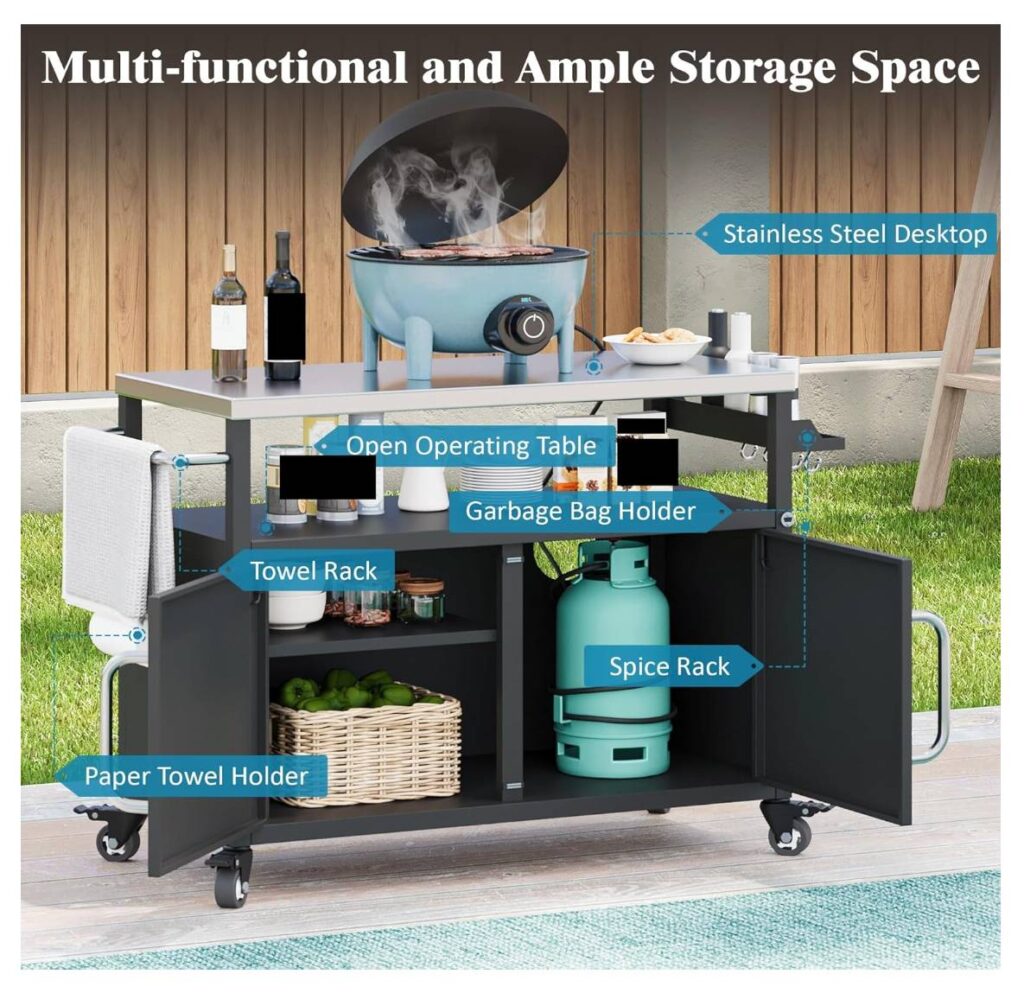
Where this cart becomes more than “just a table” is what it does under the top. The design combines an enclosed cabinet with a lower shelf/work area. In practice, that lets you split your outdoor cooking life into two zones: the things you want visible and within immediate reach (tongs, a tray of buns, your go-to rubs) and the things you want hidden but nearby (backup paper towels, lighter fluid, skewers, a stack of disposable plates). The lower shelf is usually rated for a meaningful load, which is enough for real-world storage without you worrying that you’re overdoing it with cast iron, charcoal, or a small cooler.
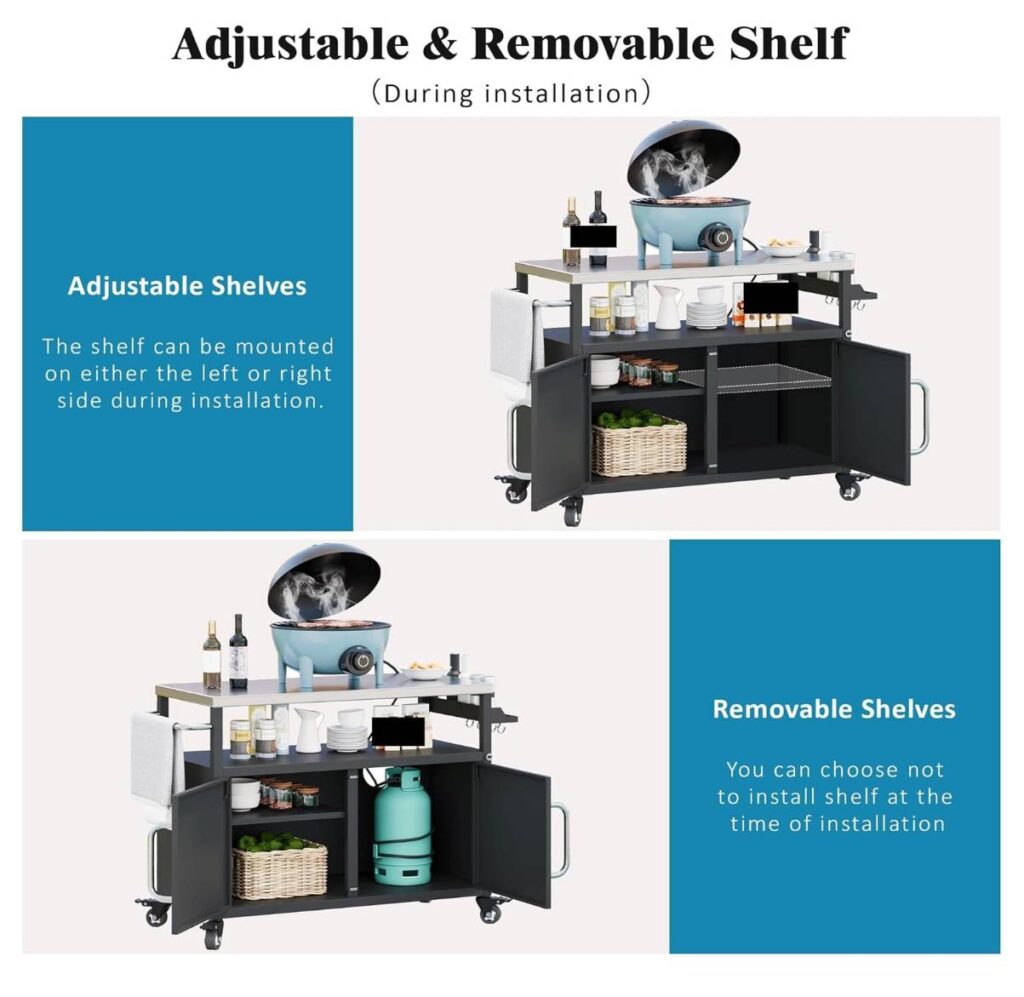
The cabinet is the part that can change how “finished” your outdoor setup feels. If you’ve ever hosted outside, you know how quickly clutter accumulates: half-open spice containers, foil, grill brushes, a bag of charcoal, a random roll of trash bags. A cabinet gives you permission to keep the patio looking intentional. And for many people, the real win is propane management. Multiple listings for this cart mention that the interior shelf is adjustable and can be removed, and that doing so can make room for a standard 20-pound propane tank in the cabinet. That doesn’t magically turn it into a sealed, built-in propane compartment, but it can help you keep fuel and supplies out of sight if your goal is a cleaner-looking grill zone.
Then there are the small convenience features. Normally, product pages throw these in as fluff, but outdoors they genuinely matter because you’re constantly dealing with hands full of food and tools. This cart is commonly described as including a spice rack, tool hooks (often as S-hooks), a paper towel holder, a trash bag holder, and even a bottle opener. Those details sound minor until you’re mid-cook and you need to wipe a spill, toss packaging, season quickly, or just keep your tools from disappearing onto random surfaces. Even if you don’t use every accessory, having multiple utility points lets you customize the cart to your habits: paper towels on one side, tongs and spatula on hooks, spices corralled so they don’t get blown around by a breeze.
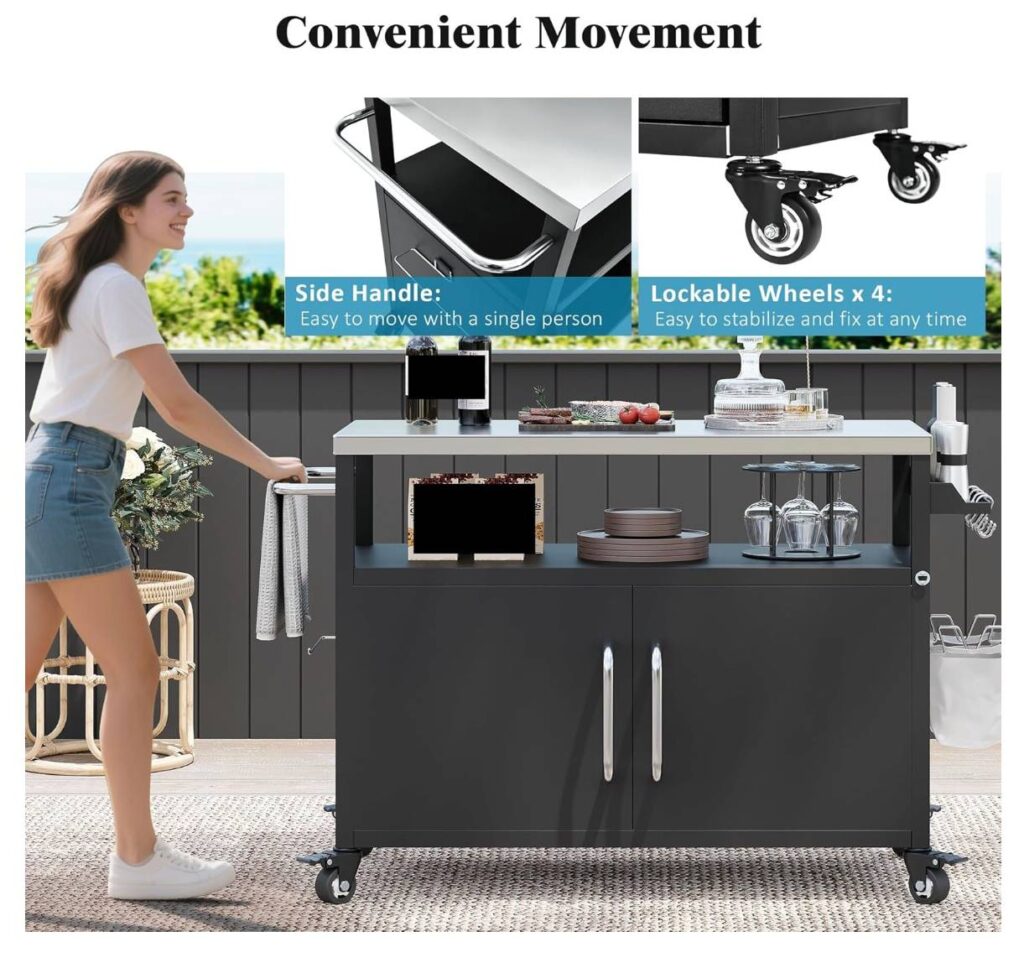
Mobility is the other big headline. Outdoor spaces change throughout the day: shade shifts, guests gather where the light is best, and sometimes you want to pull your prep station closer to the grill for the main cook, then roll it toward the seating area when it’s time to serve. This model is typically described as having four swivel casters that lock. That’s an underrated detail, because many carts only lock two wheels, which can still allow some drift when you’re pressing down while chopping. Locking all four wheels is what turns “rolling cart” into “stable work station.” On a deck, patio pavers, or concrete, that should feel smooth and confident. On grass, any caster cart will be more of a tug, but the locks still matter once it’s in place.
Assembly is the part you should plan for realistically. This isn’t a one-piece cart you pull out of a box and use immediately. A common estimate for assembly is roughly an hour (sometimes a little less, sometimes a little more), which makes sense for something with a cabinet, doors, racks, and multiple accessory mounts. If you’ve built flat-pack furniture before, it’s the same idea just with the added benefit that some packages include the needed tools. The practical advice here is simple: assemble it in the general area where you intend to use it, because at roughly 72 pounds it’s not something you’ll enjoy carrying up stairs after it’s built. Two people helps, especially when aligning the doors and squaring the frame so everything sits flush.
About that weight: 72 pounds is a sweet spot for this category. It’s heavy enough that it likely won’t feel flimsy, and it won’t tip easily if someone leans a forearm on it while chatting. But it’s still light enough that you can roll it around solo once it’s on its wheels, as long as you’re not dragging it over big thresholds or gravel. In other words, it has the mass you want for stability, without committing you to a permanently fixed outdoor kitchen island.
Material-wise, the combination of a stainless top and a powder-coated metal frame is pretty standard for outdoor prep carts at this size. Powder coating helps resist rust and cosmetic wear, but it’s not magic; if you leave any metal cart uncovered through months of heavy rain and winter freeze-thaw cycles, it will age faster. Treating it like outdoor furniture, covering it when you can, drying it after storms, and keeping it from sitting in puddles goes a long way toward preserving both the look and the feel. A quick check of screws and hardware once in a while is also part of owning a working cart; if you roll it around frequently, it’s normal for fasteners to need a re-tighten over time.
It’s also worth thinking through how you’d actually use the space. A cart that’s 54.5 inches wide and 23.5 inches deep is generous, but it will feel different depending on your patio layout. If your grill already eats up most of your working area, make sure there’s still comfortable clearance for people to walk around without bumping into your prep zone. On the other hand, if you host often, this cart can become the center of gravity for the entire event: the place where you set up buns and toppings, the station where drinks get opened, the surface where you plate finished food. In that sense, it functions like a mobile kitchen island the same way an indoor island does. It gives guests a natural place to gather that isn’t directly in your cooking lane.
A subtle advantage to a cart like this is mental bandwidth. When you’re cooking outside, you’re managing heat, timing, and social energy at the same time. Having dedicated storage and a predictable prep area reduces the number of tiny decisions you have to make mid-cook. Where’s the foil? In the cabinet. Where are the seasonings? In the rack. Where do I throw this wrapper? In the bag holder. It’s not glamorous, but it’s the difference between feeling like you’re juggling and feeling like you’re hosting.
No product is perfect in concept, and the trade-offs are worth stating plainly. A cart with a cabinet and lots of attachments means more parts, which means more assembly steps, and more places where bolts can loosen over time if you move it constantly. If you want outdoor gear that lasts multiple seasons, plan on basic care: cover it when you can, keep the top clean, and tighten hardware occasionally. The other trade-off is the “generic listing” reality: because the same cart may appear under different seller identities, your experience can depend on where you buy it. Things like return policies, warranty terms, packaging quality, and how easy it is to get support if a part arrives damaged.
If you’re the right person for this cart, you’ll know because you’re not looking for a “grill accessory.” You’re looking for a second set of hands. You want a place to prep, stage, and serve that makes outdoor cooking feel like a smooth little production rather than a chaotic scavenger hunt. If that describes you, and you have the space for a 54.5-inch-wide station, this model is a compelling option on specs alone: a large stainless prep top, real storage, and practical, host-minded add-ons that keep everything flowing.
Pros
- Large stainless prep top that’s big enough to function as a true prep station, not just a landing pad.
- Stable overall build for the category, with a weight that helps it feel planted during chopping and plating.
- Useful storage mix: an enclosed cabinet plus a lower shelf/work area to keep the grill zone organized.
- Flexible cabinet interior thanks to an adjustable/removable shelf; can be configured to store a standard 20-pound propane tank (depending on how you arrange it).
- Convenience accessories that make outdoor hosting smoother: spice rack, hooks for tools, paper towel holder, trash bag holder, and bottle opener.
- Four swivel casters that lock, helping it roll easily when needed and stay stable once parked.
Cons
- Assembly required; door alignment and keeping the frame square can take patience if you rush.
- Not something you’ll want to carry far once assembled; best built close to where it will live.
- Like most metal outdoor carts, it will last longer with basic care (covering/sheltering in heavy rain and tightening hardware occasionally).
- Because it’s commonly sold under generic/private-label listings, buyer experience can vary by retailer (returns, support, packaging, and warranty handling).


